
Snorkulus
THE SNORKULUS Hookah Diving System - MK1

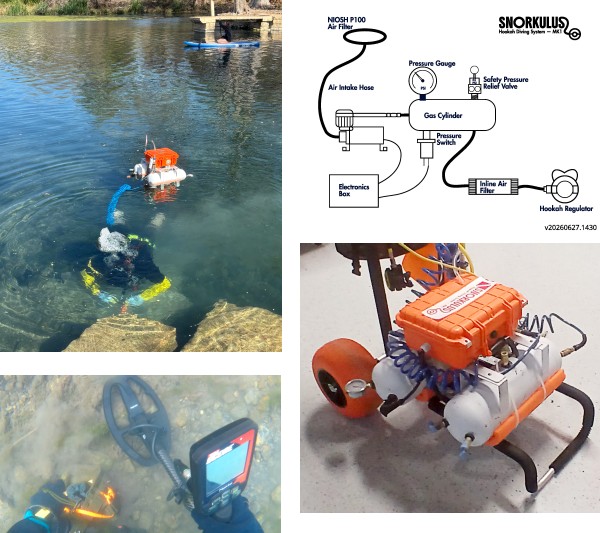
A modern-day Aerophore for shallow aquatic investigation, underwater metal detecting, gold dredging where legal, and questionable-but-carefully-considered aquatic practices.
The big idea is portability. The SNORKULUS is meant to be small enough to move, carry, repair, revise, and actually use without dragging around an engine-driven surface rig. Because it is battery powered, there is no gasoline engine sitting beside the air intake, which reduces the chance of sending engine fumes down the hose. Battery choice also becomes part of the design: more battery for longer runtime, less battery for a lighter unit.
It is built from mostly off-the-shelf automotive-style parts, which makes the system understandable and repairable. If something fails, the parts are recognizable, replaceable, and not locked inside a mystery box. Since we built it, we know how it works. Since we know how it works, we can fix it, improve it, and question it.
Safety & Legal Disclaimer
Hookah diving is inherently dangerous. Underwater breathing equipment is life-support equipment, and failure can result in injury or death.
The SNORKULUS MK1 is an experimental, home-built hookah diving system documented for informational purposes only. It is not certified, approved, professionally tested, or represented as safe life-support equipment. It is not commercial diving equipment, scuba gear, or a substitute for scuba training.
Do not trust me. Do not trust this design. Do not assume something is safe because I built it, my friends built it, it worked for us, or it appears to make air come out of a hose. A system can appear to function and still be unsafe.
There are no build instructions here. The photos, schematics, bill of materials, notes, and descriptions document what we built. They are not instructions, certification, approval, or a recommendation that you build or use the same system.
Anyone who builds, modifies, tests, or uses anything based on this documentation is designing and constructing their own device and assumes all risk. Before any underwater use, the system should be reviewed, inspected, tested, and approved by qualified professionals, including a certified dive professional, a licensed electrical engineer, and a breathing-air or life-support equipment specialist.
Anyone considering hookah diving should understand scuba-style breathing, pressure effects, ascent discipline, emergency procedures, regulator behavior, air supply failure, hose hazards, entanglement risks, contamination risks, electrical hazards, and the consequences of breathing compressed air underwater.
The operating boundary for this project is intentionally conservative: Do not use this system deeper than a place where you can simply stand up if anything goes wrong. Even that rule does not make it safe. Shallow water can still be dangerous. A person can drown in shallow water.
This project is documentation of an experiment. It is not a safety claim.
What It Is
Watch the video Short on YouTube
The SNORKULUS MK1 is a home-built, battery-powered, surface-supplied air system (hookah diving system) intended for very shallow underwater investigation.
In practical terms, we use it for underwater metal detecting in places where people gather for water activities: swimming areas, beaches, shallow lake bottoms, dock areas, and other spots where rings, keys, coins, jewelry, fishing gear, and random metallic mysteries tend to disappear.
The goal is not deep diving. The goal is not extended underwater adventure. The goal is controlled, shallow, careful searching in places where a person could stand up if something goes wrong.
The system supplies air through a hose from a compressor and tank arrangement rather than from a scuba cylinder carried on the diver’s back. This makes it useful for slow, close-up searching with a detector, but it does not make it safe by default. Hookah diving still involves pressure, breathing gas, hoses, electricity, entanglement hazards, equipment failure, panic risk, and the same basic rule that applies to all underwater activity: If you do not know exactly what you are doing, you should not be doing it.
What It Is For
The SNORKULUS was built for shallow-water metal detecting and recovery work.
Typical use cases include searching for lost rings, investigating metal detector targets underwater, checking swimming areas, and exploring shallow water where breath-hold searching becomes awkward or inefficient.
Most underwater targets are not treasure. They are pull tabs, bottle caps, fishing weights, rusty hardware, and the archaeological remains of snacks, boats, bad decisions, and summer afternoons.
But sometimes the target is a ring.
Sometimes it is a key.
Sometimes it is something someone thought was gone forever.
That is the narrow little world the SNORKULUS was built for: shallow, careful, treasure-adjacent searching where patience matters more than depth.
What It Is Not
The SNORKULUS MK1 is not scuba gear.
It is not commercial diving equipment.
It is not certified breathing-air equipment.
It is not tested or approved life-support equipment.
It is not intended for deep water, moving water, cold water, overhead environments, caves, wrecks, rivers, surf, boat traffic, poor visibility, solo heroics, or any situation where standing up immediately is not a realistic emergency option.
It is also not a substitute for scuba training. Anyone who wants to use hookah diving equipment should understand scuba-style breathing, pressure effects, ascent discipline, emergency procedures, regulator behavior, air supply failure, hose hazards, and the consequences of breathing compressed air underwater.
I strongly recommend that anyone using a system like this be scuba certified and get professional instruction specific to hookah diving.
How Deep Can It Go?
This has been the single most asked question when someone sees us using the system.
It is not a good question for many reasons.
The SNORKULUS MK1 is not meant to go deep. It is meant for shallow water where standing up is a realistic emergency option.
At around 33 feet of seawater, pressure is roughly double surface pressure. Deeper and longer dives bring in more serious concerns: ascent discipline, nitrogen loading, decompression planning, bailout gas, and training.
If the surface air fails at depth, you need a backup breathing supply. If that means carrying scuba tanks anyway, the obvious question is: Why not just use scuba?
Treasure hunting, metal detecting, and dredging can also require a diver to be negatively buoyant. Tools, weights, recovery bags, current, mud, and task loading can make ascent harder and increase the chance that a diver may need to drop a weight belt or ditch gear.
For this, the rule is simple: Do not use this system deeper than a place where you can simply stand up if anything goes wrong. But even then always keep in mind that it is possible for things to prevent one from standing up.
Gallery
This gallery shows off the innovative and different ways that the group of people who built these put them together.
First Build - Viktor’s Prototype
Viktor built the first version, originally called the “Hookah Dive System MK1” or “Scooba Brothers 1.” The goal was simple: make a working unit.
It worked, but it also revealed the big problems to solve. The prototype is top-heavy enough to risk capsizing, and the air outlets sit below the waterline, creating a concern about water entering the line if the hose was connected while submerged. Even with aluminum tanks, the weight added up quickly. It is heavy enough to require quite a bit of muscle to get it safely in the water.
Tom's Rig
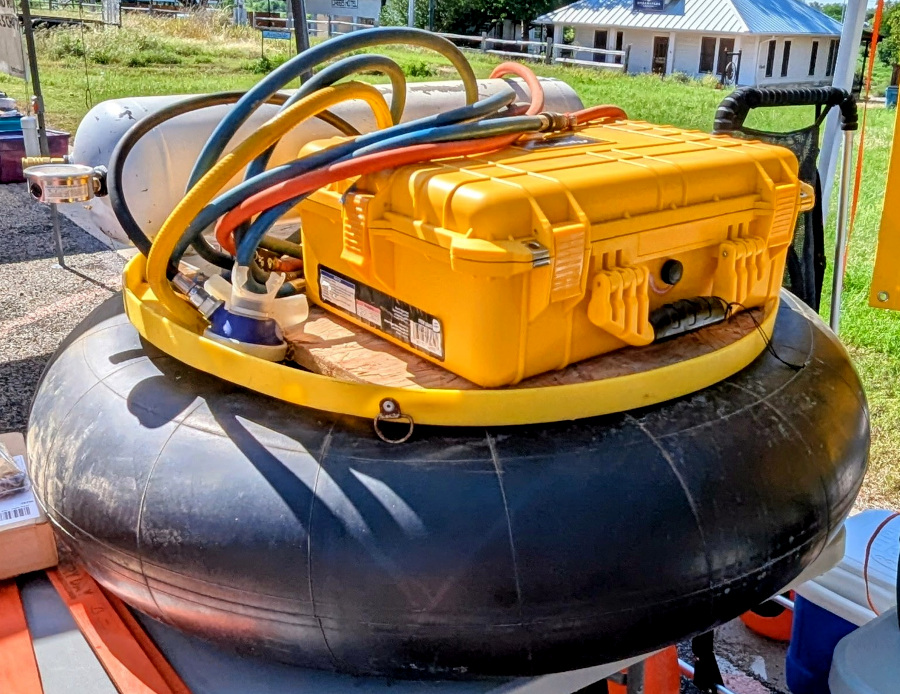
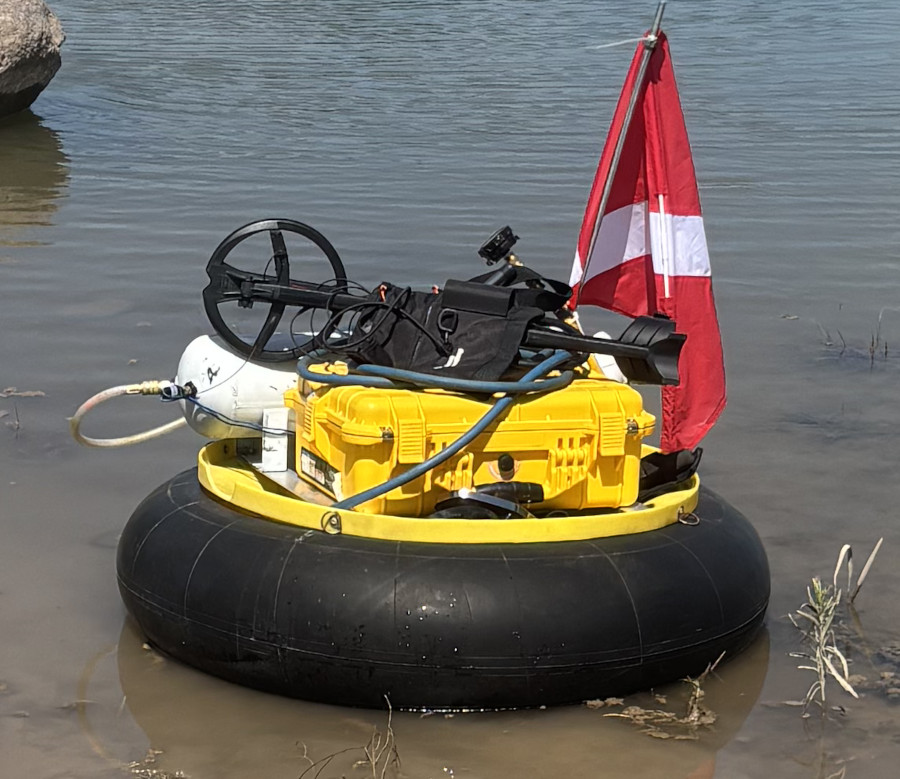
This was the second SNORKULUS built, designed around extended underwater time. It uses a 100Ah battery and a large innertube that gives the diver a place to surface and rest.
Tom built this version from more than 50 years of scuba, hookah diving, and underwater gold dredging experience.
Einida's Light Build
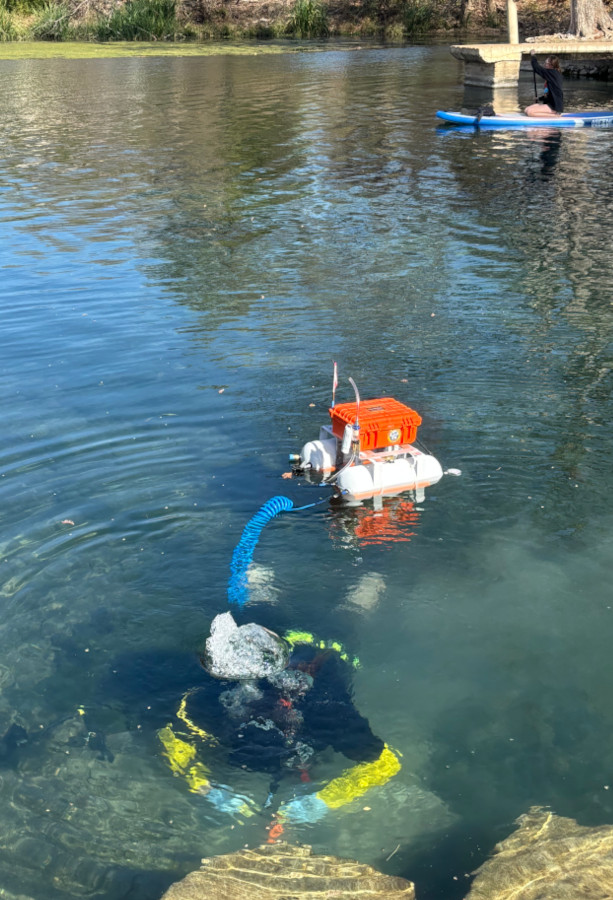
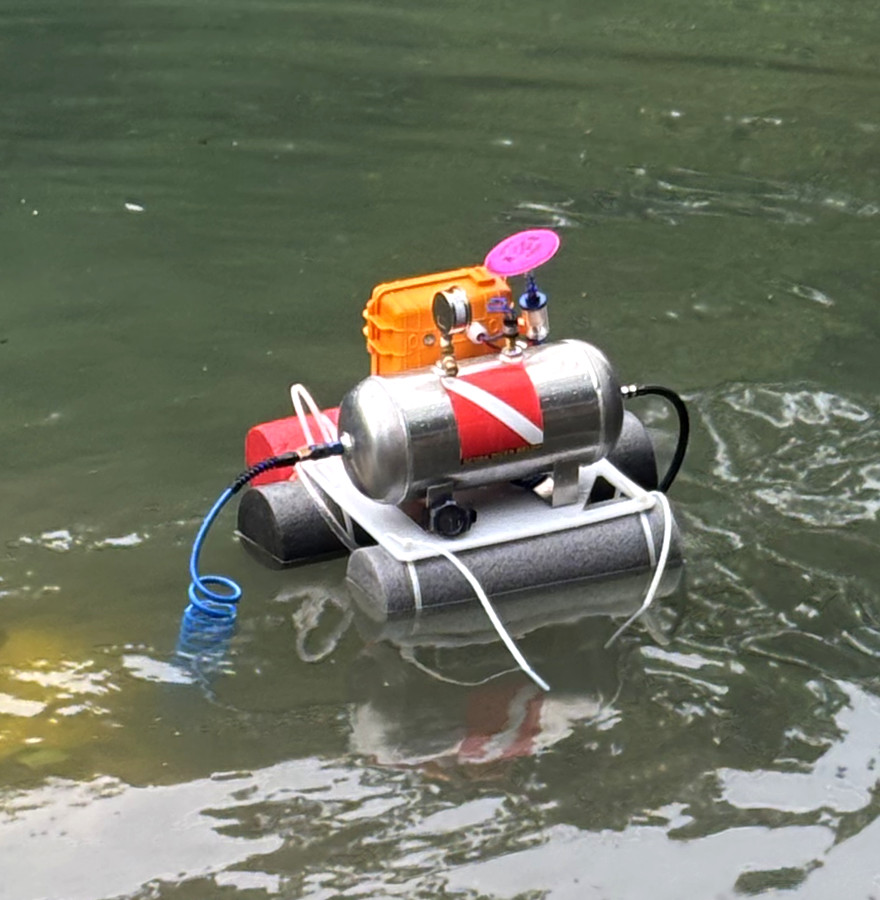
Einida built her SNORKULUS around minimum weight and easy transport. She used a 20Ah battery and a smaller compressor, making the whole unit light enough to carry easily down to the water’s edge.
Her version trades maximum runtime for portability, which is exactly the point: a compact system that can be moved, launched, and used without fighting the equipment before the dive even starts.
Notice that the floats used here are Yoga foam Rollers. We added a 3rd one to make it more stable and to balance the weight to keep it from capsizing.
Davids mobile build
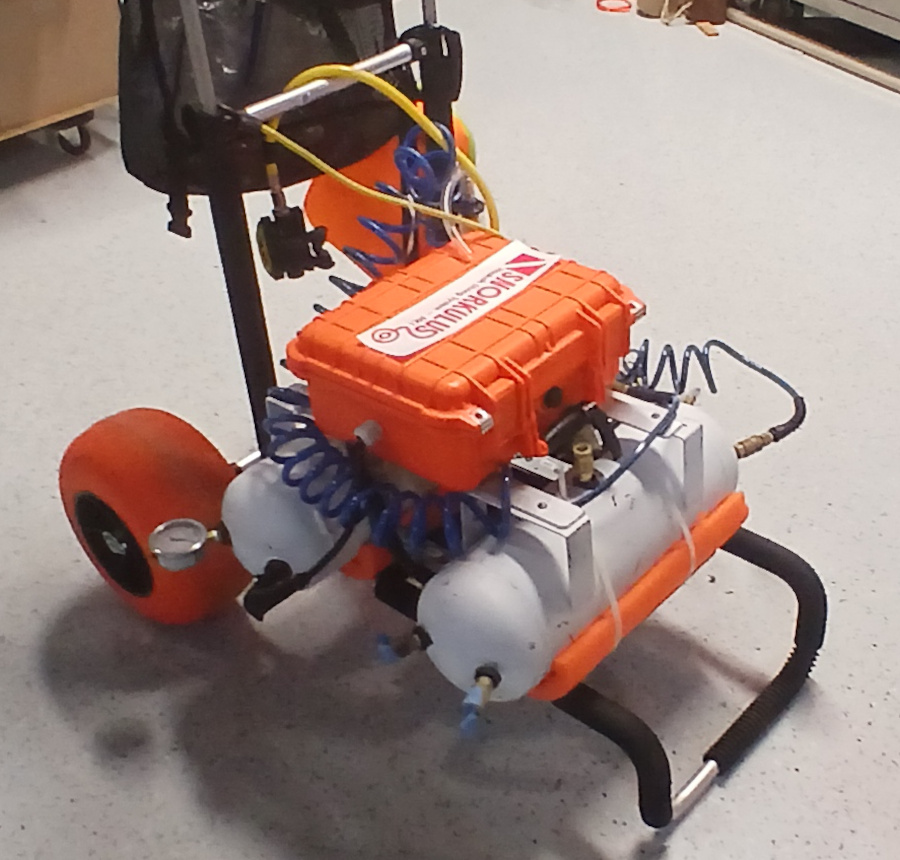
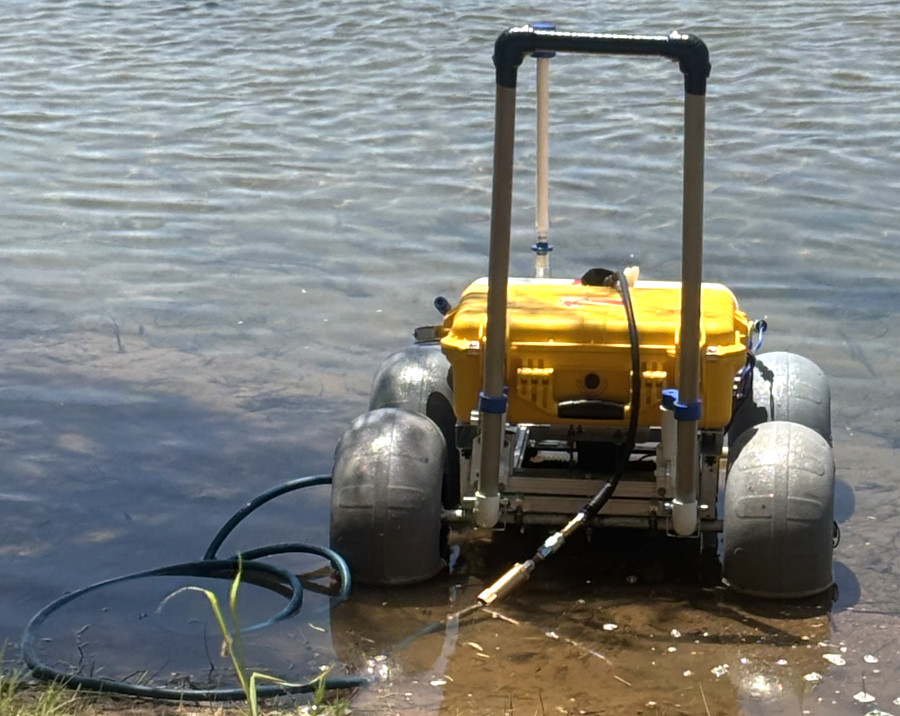
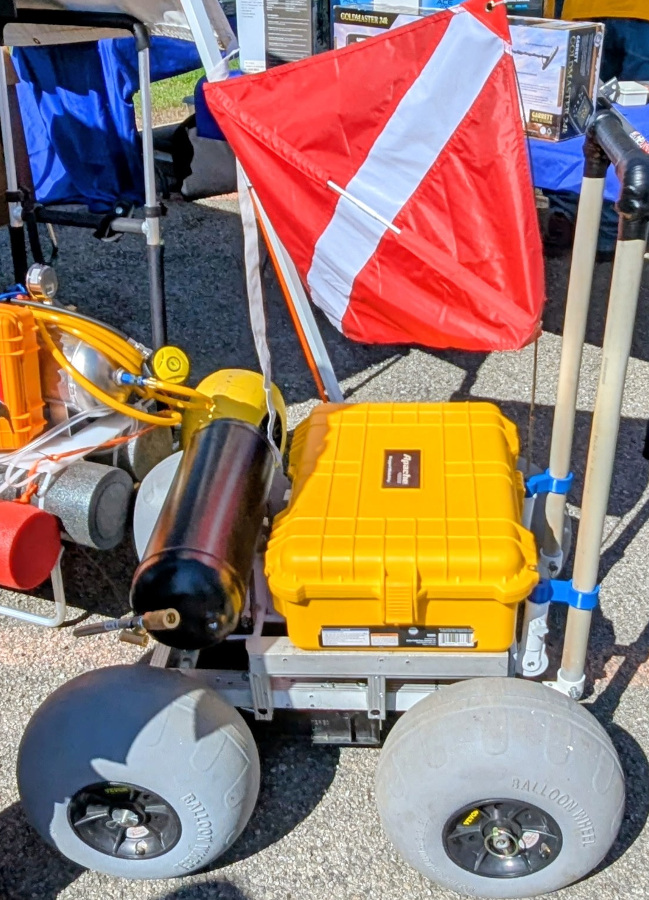
David built his SNORKULUS as an all-in-one cart system. The entire setup is mounted to a beach cart that can be wheeled directly into the water, with the cart’s beach tires also serving as flotation.
His build was a real “wow” moment for the rest of us: practical, clever, and immediately obvious once you saw it.
How It Is Built
The SNORKULUS MK1 is made primarily from automotive-style components.
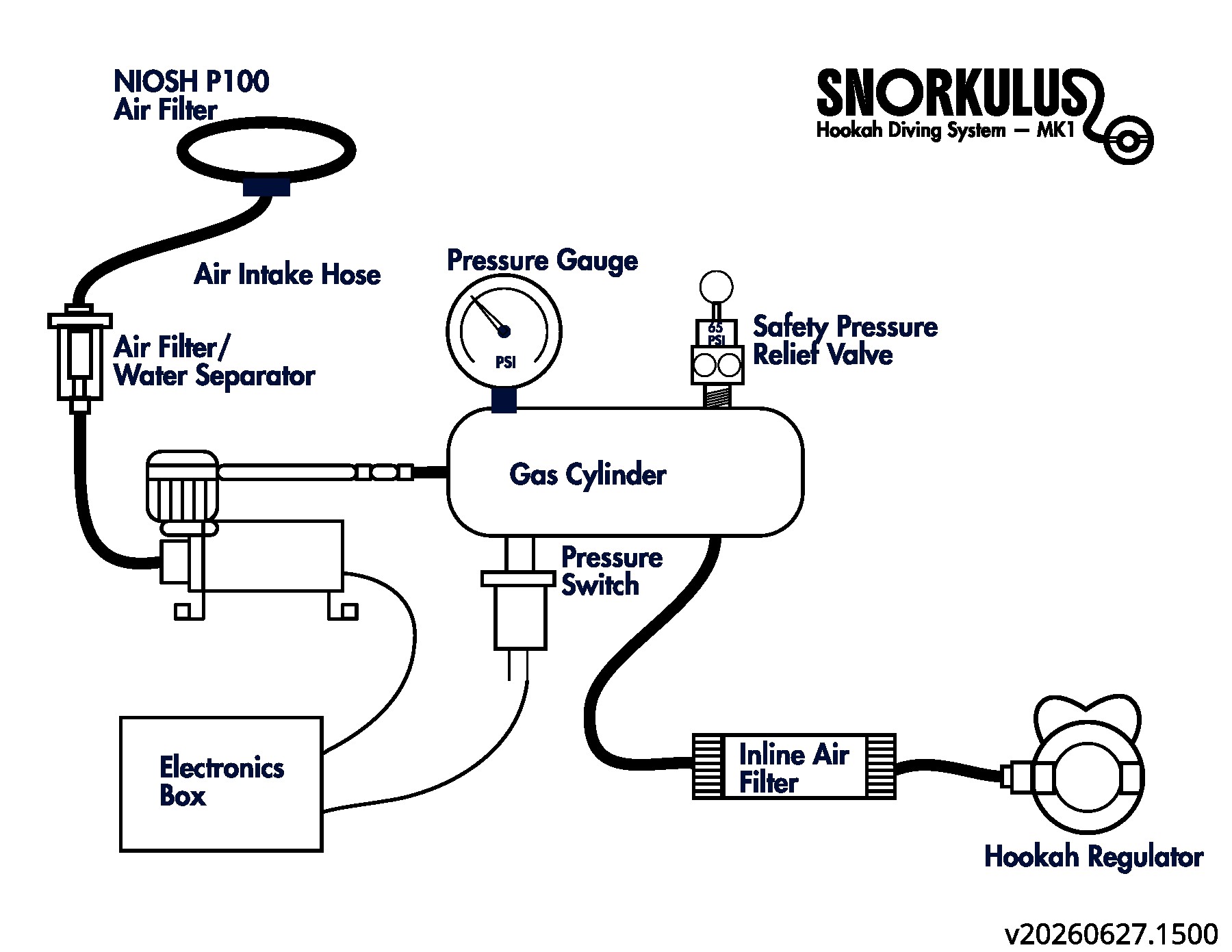
The core of the system is an air horn compressor connected to an air storage tank. The compressor used in this build is sealed and can run underwater, which helps keep the compressor cool during operation. The compressor used for this version is also rated for 100% duty cycle.
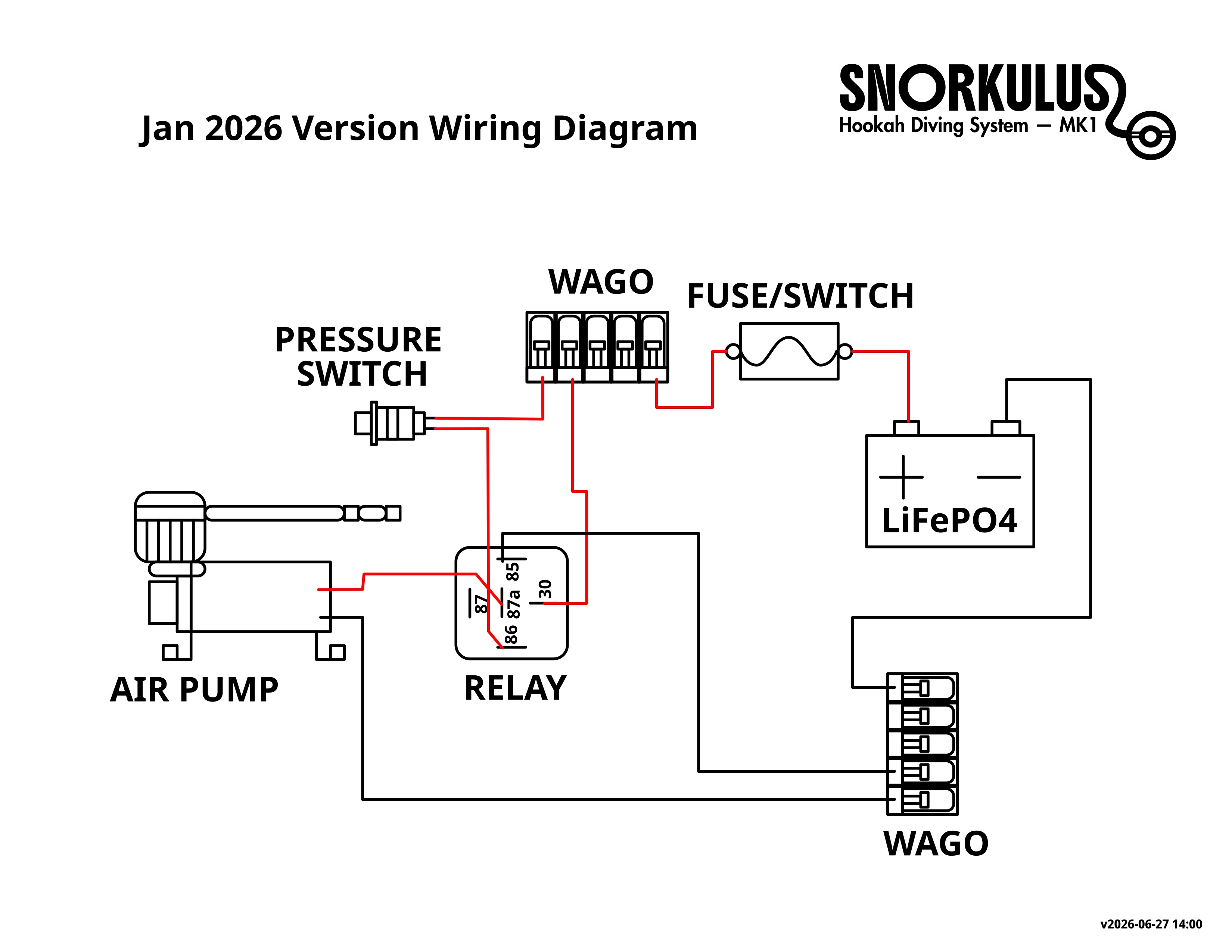
A pressure switch turns the compressor on and off as needed to keep the tank in the intended operating pressure range. In this version, that switch operates around 45–60 PSI. A 65 PSI pressure relief valve is included to help prevent the tank from exceeding the intended maximum pressure.
It is important to always keep spares of all equipment on hand.
The system is powered by a 6-24Ah battery. In our use, that has provided about four hours of runtime, although actual runtime depends heavily on the person using it, breathing rate, conditions, battery health, compressor behavior, and how efficiently the diver breathes through the regulator.
The air path includes multiple filters, including a 3M NIOSH P100 particulate filter and two additional filters. These are included to reduce particles in the incoming air path, but they do not prove that the air is safe to breathe. Filtering particles is not the same thing as certifying breathing air. The air quality of this system has not been professionally tested.
The build details, photographs, circuit schematics, and bill of materials shown on this page document what we built. They are not proof of safety.
Bill Of Materials
| Item | QTY | Price | Total | Link | Alternate | Notes |
|---|---|---|---|---|---|---|
| Tanks | 1 | $69.99 | $69.99 | Link | Alt | |
| Pressure Switch | 1 | $18.96 | $18.96 | Link | Alt | |
| Battery | 1 | $55.99 | $55.99 | Link | Alt | |
| Battery Charger | 1 | $35.99 | $35.99 | Link | ||
| Relay | 1 | $6.75 | $6.75 | Link | ||
| Inline Fuse Switch | 1 | $14.99 | $14.99 | Link | ||
| Spade Connectors | 1 | $24.99 | $24.99 | Link | ||
| Wago Connector | 1 | $20.95 | $20.95 | Link | Alt | |
| Air Intake Filters | 1 | $12.99 | $12.99 | Link | ||
| Misc Pipe Fittings Kit | 1 | $39.99 | $39.99 | Link | ||
| Quick Connect Male | 1 | $14.99 | $14.99 | Link | ||
| Quick Connect Female | 1 | $8.99 | $8.99 | Link | ||
| Pressure Gauge | 1 | $9.99 | $9.99 | Link | ||
| Blow Off Valve | 1 | $11.45 | $11.45 | Link | ||
| Inline Filter | 1 | $16.55 | $16.55 | Link | ||
| Inline Filter Adapters | 2 | $9.99 | $19.98 | Link | ||
| NIOSH P100 Filter | 1 | $17.48 | $17.48 | Link | ||
| Hookah Regulator | 1 | $39.99 | $39.99 | Link | Alt | |
| 10GA or 12GA Wire | 1 | $14.99 | $14.99 | Link | Alt | |
| SCUBA Dive Hose | 1 | $99.99 | $99.99 | Link | ||
| Dive Hose Adapters | 1 | $7.99 | $7.99 | Link | ||
| Cable Loom | 1 | $5.03 | $5.03 | Link | ||
| Water Tight Case | 1 | $23.99 | $23.99 | Link | ||
| Stainless Bonded Washers | 1 | $8.45 | $8.45 | Link | For Attaching Case to Base | |
| Total | $601.45 |
To convert the NIOSH P100 filters to fit hoses we use these.
3D Printed Adapter for P100 to hose. STL FreeCad
Build Documentation
This page includes documentation from four systems built and used by me and friends.
The photos show real examples of the project as constructed. The schematics show the electrical layout used for these builds. The bill of materials shows the parts we selected. The build notes explain how our systems were assembled and arranged.
This information is provided so the project can be studied, criticized, improved, inspected, and understood. It is not provided as a claim that this is the correct way to build a hookah system, and it is not proof of safety.
Testing Status
This system has not been professionally tested for breathing-air quality, pressure behavior, electrical safety, water sealing, failure modes, regulator compatibility, hose safety, filtration limits, contamination risks, or emergency shutdown behavior.
It has not been certified as life-support equipment.
It has not been approved by a dive equipment manufacturer, breathing-air specialist, electrical engineer, or regulatory body.
It has been built, used, revised, and documented as an experimental project. That is not the same thing as being safe.
If you do not have the equipment and expertise to test a system like this properly, find someone who does.
Inspiration
This project was inspired by Tom of Prospectors Cache
Final Note
The SNORKULUS MK1 exists because shallow underwater metal detecting is fascinating, frustrating, and occasionally rewarding.
It is a tool for exploring the small underwater places where people lose things and sediment keeps secrets.
But curiosity is not a safety system.
A pressure switch is not a safety plan.
A filter is not proof of breathable air.
A successful test is not certification.
A homemade system is not life-support equipment just because it works once, twice, or all summer.
Study it. Question it. Improve it. Get it inspected. Get trained. Be careful.
Adventure is optional.
Breathing is mandatory.